top of page


🌍 ENVIROMENTAL IMPACT
LESS SPACE. LESS HARM. MORE EFFICIENCY.
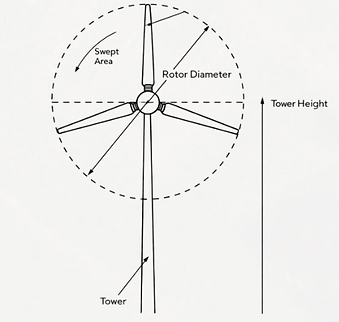
Urban wind energy often faces a critical trade-off: increasing energy output usually means larger blades, wider swept areas, and higher risks for surrounding ecosystems.
WindBenders was designed to challenge this trade-off
Based on our swept-area analysis, reducing blade length directly lowers the physical space where collisions and turbulence occur. Compared to conventional horizontal-axis turbines, WindBenders operates with a significantly smaller swept area, while maintaining effective wind capture through its hyperbolic, flow-guiding geometry.
Shorter blades also result in lower tip speeds, decreasing the potential impact force on birds and airborne wildlife. This makes the system inherently more suitable for dense urban and semi-urban environments, where biodiversity and human proximity are critical constraints.
Additionally, the compact form enables higher installation density without increasing wake losses, allowing more energy to be generated per square meter with less material usage and reduced environmental footprint.
Tradıtıonal Design Assumption
Long blades with a large sweeping
area are used
Designed for open, unobstructed terrain
Long blades are optimised for low winds
Environmental impact is a secondary design criterion
It is assumed that the wind will predominantly come from a single direction
real-world outcomes
Turbines cannot be placed close to each other, leading to inefficient land use.

Performance remains limited in areas with buildings and terrain obstacles.
At high wind speeds, the system shuts down to protect itself.
Long blades with a large sweeping
area are used
The risk of interaction with birds and the surrounding environment increases.
And this is where WindBenders comes in.


Suitable for urban areas and confined spaces
Continuous Operation Across Variable Wind Speeds
A Turbine Designed to Coexist with Its Environment
bottom of page